Iowa Park in the Great War: Part 2 The fight at Forest Farm
(This is Part 2 of a three-part series. This story contains graphic depictions of war violence, reader discretion is advised.)
Daniel Walker
Iowa Park Journal
On Sunday, October 27, 1918, the 36th U.S. Infantry Division led by Company K, composed mostly of troops from Wichita County, including Iowa Park, on point, was tasked with eliminating German positions in a loop of the Aisne River, the position was known as Forest Farm. A 1.5-mile trench stretched across the entrance to the loop, felled trees and three belts of barbed wire, “each five posts deep” stood in front of the trench. Three strongpoints, machine guns and protected by wire, one on the left, one toward the right, and one to the rear, covered the trench together with 60 or more machine gun nests held the position.
Two French attacks on the position in the previous weeks had been repulsed, and the Americans were handed over the task. This battle was memorable as it marked the first use of Indian “Code Talkers.” These were Choctaws assigned to each company to transmit information in the battle in their native language to foil the Germans, who had tapped the American phone lines.
Company K was dug in on the north side of a quite large apple and plum orchard. Sixty yards away from the German trench. The 47 men and one officer left fit for duty feasted on canned salmon and bread as they waited for the hour to attack.
Shortly before the zero hour, the four NCOs, including Burkburnett’s Cecil Birkhead (see his letter from the front in Part 3 of this series), were briefed at the command post, located in a wine cellar. Empty wine racks lined the wall. A rickety table held the maps, illuminated by flickering candle stuck in an empty bottle.
At 4:10 p.m. a gun of the 2nd Artillery signaled the beginning of a 20-minute preliminary bombardment of the German positions. The artillery commenced a rolling barrage and then the officers blew their whistles for the infantry, including Company K, to go over the top.
The assault troops advanced in two waves, ten paces apart, a little over 100 yards behind the “creeping” barrage. The first wave was composed of automatic riflemen and hand grenadiers while the second consisted of automatic riflemen, “ordinary” riflemen, bombers, and rifle grenadiers. An otherwise perfect attack was marred only on the right where an artillery battery commenced firing two minutes late and dropped its shells largely on Company M of the 142nd Infantry.
Engineers with the first wave cut the enemy wires and the infantrymen poured through and into the German trenches, dugouts, and strongpoints before the enemy, who were still in their shelters as the result of the artillery barrage, “realized what had happened.” Some resisted, but the majority surrendered on the spot. In less than one hour the assault battalions fired their green star shells into the air as a signal of mission accomplished.
During the quick engagement, it was estimated that the Americans killed 40 Germans, and captured 109 prisoners with 21 Maxim machine guns. Birkhead was credited with capturing seven Germans, and took out a machine gun nest. Casualties were considered light as the Americans suffered eight soldiers killed and 20 wounded.
The first to die were two 21-year-old soldiers from Company M: Haskell County’s Edgar Smith and Alford Brown.
They were sheltering in a dugout, waiting for the artillery bombardment to cease before the attack. A friendly fire shell hit their dugout during the creeping barrage, killing both. Brown had earned a Croix de Guerre with a silver star for “extraordinary heroism” two weeks earlier.
With the whistle blowing, signaling the attack, the men left cover and attacked. Within seconds, Iowa Park’s Corporal Bruce Cobb, 23, was shot in the chest by a sniper, as the men advanced to the barbed wire. 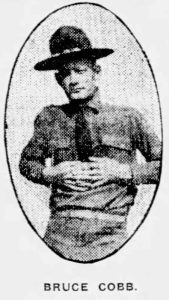
“Look out or he will get you,” Cobb cried as he fell.
Private Robert Lynch saw the sniper’s location and shot him. In his book describing the attack Arch Hart recalled that Lynch’s shot did not
kill the German sniper. He had sustained a head wound. Later, the Company K soldiers pulled the German out of his dugout and “laid him on the ground, within arm’s reach of Cobb’s lifeless body.” When stretcher bearers took Cobb’s body away, Hart said he asked them to come back and pick up the wounded German.
At around 4:35 p.m., Oscar Fry, the Iowa Park farm boy who had been among the first to enlist, was knocked down by an artillery shell that landed a few feet behind him. The same shell threw Iowa Park’s Miles Hines in the air, he landed five feet to the right. Hart, who was knocked down by the same shell, said Hines got up, dusted himself off and “looked mad enough to fight a cop.”
Hart then asked Fry if was hurt. “He raised up and shook his head that he was not.” When Hart urged him to keep moving, Fry “kindly laughed and said that he couldn’t go any farther,” and Hart left him. Another account reported Fry smiled, didn’t say anything but shook his head no when asked if he was hurt. The soldiers were shocked to later learn that Fry died from internal injuries from the explosion. 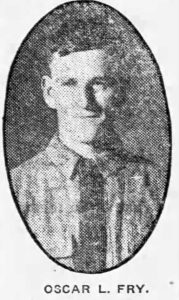
Sometime during the counter barrage, Hardeman County’s Charles Montgomery, a 23-year-old battalion runner, was killed by shrapnel from a falling shell that hit him in the back.
Denton County private Will C. Curtis was next to fall. The 24-year-old was struck in the helmet at the right temple by a 37mm shell as the men advanced on the German positions.
John Perkins, an automatic rifleman from five miles north of the Red River in Oklahoma was advancing with his loader, Will Mounger. Mounger recalled a machine gun started firing at them. Perkins told him to “lay down” and then was hit in the left side. He cried, “Oh Lord,” as he fell and died four feet from Mounger.
The final casualty of the attack was Sgt. Albert Robinson of Vernon. Cpl. William A. Jones wrote: “I was within 10 steps of Sgt. Albert E. Robinson when he was instantly killed by shrapnel. He was standing when struck. The objective having already been gained. After being struck he fell on his left knee, his right leg being straight behind him, both his elbows were on the ground and his head between his arms.
Birkhead, the Burkburnett railroad worker before the war, was judged the luckiest soldier in Company K, according to Hart. Hart recalled that Birkhead walked up to a group of soldiers, and had a sizable dent in his helmet. Birkhead responded: “I thought they were lobbing over brick-bats when that hit me.” Birkhead’s pants had also been sliced at the knee by shrapnel, but he had not been touched. And, Hart said, his third close call had to be seen to be believed. A bullet had gone in one side of his mess kit, sliced his knife and fork in two, and gone out the other side of the canvas bag.This was the final engagement for the local Texoma soldiers in World War 1. The 36th Division was marched off the front line into a reserve area to refresh for a future assault. That assault never happened as the war ended two weeks later on November 11.
Iowa Park’s Cobb and Fry were initially buried in France. Their bodies were repatriated and buried in Iowa Park in 1921.
They were not the only Iowa Park soldiers that paid the ultimate sacrifice. Sidney McSpadden was drafted into the 360th Regiment of the 90th Division. He was a 21-year-old mechanic in Iowa Park when he was drafted on April 18, 1918. He sought an exemption for his leg that had not healed correctly from a broken bone – that exemption was denied. He was killed in action on Sept. 15, 1918 at the battle of St. Mihiel. Iowa Park’s Marion Jones and Roy Coleman were also reported killed in action as draftees with the 90th division.
Miles Hines, the soldier thrown in the air with Fry, returned to Iowa Park, marrying Cleo George on Nov. 9, 1919. He served 16 years as Wichita County commissioner, and was treasurer of the Iowa Park United Methodist Church for 26 years. He died in 1972 and is buried near Fry in Highland Cemetery.
Notes
Arch Hart, Company K of Yesterday, Pp 123-124, 127.
CH Barnes, History of the 142nd, Pp 141, 143, 155
Iowa Park Herald, March 2, 1972
Forest Farm Engagement, Operations Report, October 27, 1918, 3; RG120, 36th Division, 142nd Infantry Regiment, Box 14, Memorandum from C.O. 142nd Infantry to Commanding General, 36th Division, subject: Machine Guns captured in Forest Farm engagement, November 6, 1918.
Continued Tomorrow: A letter from the Front.