Iowa Park in the Great War: Part 1 of 3
(This is Part 1 of a three-part series)
By Daniel Walker
Iowa Park Journal
In April 1917, the United States congress issued a declaration of war against Germany, plunging America into the Great War.
Patriotism ran high as the small U.S. military ramped up to fight a global conflict. To bolster the small national army, Texas pledged to recruit 12,000 men for a new National Guard unit. Fourteen companies, containing 2,000 men from across northwest Texas, were authorized in June 1917 to make up the 7th Texas. Two of those companies (Company F and Company G) of 150 men each were approved to be recruited from Wichita County.
Recruiting was quick, with a big push at the July 4 holiday, the rosters were full by mid-July, 1917.
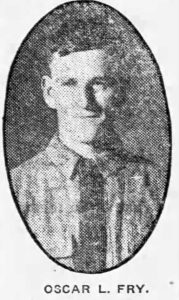
Seven of the recruits came from Iowa Park. Oscar Fry, a tall 22-year-old with grey eyes and brown hair, was a laborer on GE Brooks farm outside of town. His parents lived in Iowa Park. John Clarence Beasley, was a 19-year-old farm laborer, working with Fry on the Brooks farm. Beasley and Fry went to a rally in Wichita Falls and joined the guard unit forming there on July 11, 1917.
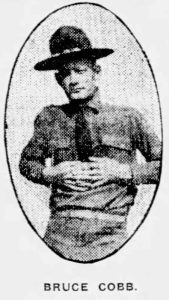
Bruce Cobb was a 22-year-old barber in Iowa Park. He worked at the Morse Barber Shop in downtown. He traveled to Burkburnett to join the guard company forming there on June 30, 1917.
Miles Hines was 19, and still living with his parents. He went to Electra to enlist on June 29 . John Litton was a 21-year-old farmer and enlisted in Wichita Falls on July 18. After the war Beasley and Hines returned to Iowa Park and raised families. Beasley died in 1955, Hines died in 1972 and both are buried in Highland Cemetery.
Not all the locals that joined the Texas guard stayed with the original Wichita County company. Harvey Fowler, was 18 and worked on a farm when he enlisted. Warren Edwards was 23 and an oil field worker for the Magnolia Company at his enlistment. Fowler would transfer into a supply company, serving as a wagon driver during the war. Edwards was transferred into a machine gun company, he went through heavy fighting in October 1918. A written account by Edwards of his time at the Front is held by the U.S. National Archives. (See Edwards transcribed letter in a future edition of this series).
The 7th Texas guardsmen were mustered into national service on August 15, 1917. However, the training camp in Fort Worth was not completed. The Wichita County companies moved to Lake Wichita to train. The soldiers were short of uniforms and supplies. The men slept in “canvas cottages” and “idle streetcars” around the lake. A consignment of uniforms, tents, cots, and blankets arrived on August 23. Each man received two pair of pants, two shirts, one service hat, a pair of leggings and a pair of shoes. Each man also received a khaki-bound New Testament. The soldiers drilled, held mock bottles, and indulged in poker games while stationed at the lake.
Camp Bowie was ready by the first week of September and the two Wichita County companies boarded a train at 10 p.m. on September 4, 1917 headed for Fort Worth. Camp Bowie would eventually total nearly 3,000 buildings on 1,500 acres.
Failed health inspections whittled away a third of the men upon arrival. To increase the unit’s manpower for national service, the 7th Texas was joined with the 1st Oklahoma on October 15, 1917 to become the 142nd Infantry of the 36th Division.
Companies F and G of the 7th Texas were combined into a new Company K of the 142nd Infantry.
The 36th Division was shipped to France in the summer of 1918. The men left Camp Bowie on July 12, 1918, traveling by rail through Little Rock, Memphis, Tupelo, and Atlanta, then north through Virginia, Washington DC, and Philadelphia to arrive in New York on July 15. That night Company K slept under the stars in a weedy field in Brooklyn. The next day they traveled to the Hoboken pier and were given a cup of cocoa and a sandwich. They then boarded the USS Lenape. Some 13 days later they dropped anchor in Brest, France and marched off the ship on July 31.
Cobb’s parents in Iowa Park received a letter on August 31 from their son reporting that he had had safely arrived in France. For the next two months Cobb and the men of the 142nd trained for the front, and adjusted to France. Company K was selected to serve as an honor guard for the American commander, General John Pershing.
The 142nd, with Company K, was moved under cover of darkness into the front-line trenches on October 6, 1918 and went over the top on October 8 in an attack against machine gun nests, through barbed wire, under constant artillery shelling, gas attacks, and strafing from airplanes.
The 142nd would spend the rest of October in near constant engagement with the German defenders. Company K entered the trench with 148 men and six officers. In three weeks of action Company K sustained 52 men wounded, 8 killed in action and 4 later died of wounds. The war would be over by more than a week and the celebrations had concluded when the town would learn the grim news that two of those killed were from Iowa Park.
Continued Tomorrow: The Fight for Forest Farm