Iowa Park in the Great War: Part 3 Wichita County Letters from the Front
Daniel Walker
Iowa Park Journal
[email protected]
(This is Part 3 of a series on Iowa Park in World War 1)
Several letters from a Great War soldier from Wichita County are held by the U.S. National Archives. One was written by Iowa Park’s Warren Edwards and other was written by Burkburnett’s Cecil Birkhead, Vallie Musick, and Walter Hardeman. Both were a a rest camp in France on Nov. 10, 1918 when they were asked by the Division’s morale officer to record their experience in combat as they came off the front line.
Warren Edwards
Edwards was 23, living in Iowa Park and employed as an oil field worker for the Magnolia Company when he joined the 7th Texas National Guard in the summer of 1917. He was of average height and build with grey eyes and brown hair.
Edwards was transferred into a machine gun company and went into combat on the front lines in France on October 8, 1918. (See previous stories).
Edwards was one of several soldiers from the 36th Division returning from the Front, who while stopped in a YMCA rest camp were asked to document their war experience while it was still fresh in their minds.
He wrote of being frustrated when his commander got lost, the dangers and hardships he faced, of picking up souvenirs on the battlefield, and the uncertainty of being able to keep them.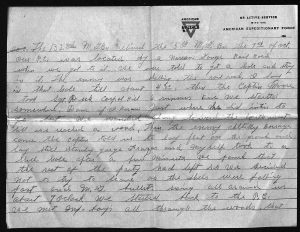
His account is transcribed with notes in parenthesis and reprinted here for the first time. Spelling is unedited.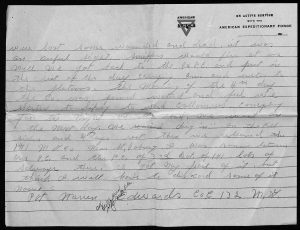
Edwards wrote: “(Co. C is marked out) The 132nd M.G. Bn (Edwards was in the 132nd Machine Gun Battalion) relived the 5th M.G. Bn the 7th of Oct. Our P.C. was located by a Narrow Gauge Rail Road. When we got to it, we were told to get a hole and stay in it. The enemy was shelling the rail road. I lay in that hole till about 4:30. Then the Captain Morris (John T.) took Sgt. Peek (Joe), Corpol Hill (Edwin N), 6 runners and we started somewhere. Dam if I know just where he did intin to go but we wanderd along toward the South west till we reached a wood. There the enemy artillery barrage come the captain told me to lay flat on the ground and lay still. Stanley, George, Frazer and myself took to a shell hole. After a few minutes We found that the rest of the party had left so we decided not to try to leave as the shells were falling fast and M.G. bullets sang all around us. About 9 oclock we started back to the P.C. We met Inf. boys all through the woods that were lost some wounded and dead. it was an awful night. Snipers would fire at us. Well we got back to the Co. P.C. and put in the rest of the day carrying am. (ammunition) and water to the platoons. The morning of the 4th day the Co. was formed waterd and feed. We started to hiking to ward collomms, company for this night on the road. We went on the next day. We [crossed out] dug ‘in” on the Hill sides and 4 days rest then we releaved the 141 MG Co near St. Voburg. I was runner between our P.C. and the P.C. of 3rd Bat. of 141. Lots of scrap there I got my part of it but think I will have to discard some of it now.
Pvt Warren Edwards Co C 132 M.G.
Cecil Birkhead
Cecil Nichols Birkhead was working as a warehouseman for the WFNW Railroad when the United Stated entered World War 1. A native of Missouri, he was 21 and living in Burkburnett. He was single with blue eyes and brown hair. He joined the newly formed National Guard unit in Burkburnett on June 28, 1917. He was promoted to Corporal on April 4, 1918, then Sergeant on Nov. 5, 1918 and Sergeant 1st class on March 1, 1919.
Birkhead married Nina Hood on June 24, 1919. He worked as a real estate agent after the war. After retirement, he and his wife volunteered teaching on the Navajo Reservation in Arizona. He died on March 2, 1968 and is buried in Oklahoma City. More of his time at war is in part 2 of this series
Birkhead wrote: “On the morning of Oct 7th our Div went to the Champaine front to relieve a Div of Marines. I believe they was the 2nd Div. The 1st and 2nd Batt of our 142nd Regiment went on the front line. So this put the 3rd Batt in support. 
“On the morning of Oct. 8th our 3rd Batt went over the top for our first time. Our starting time was 6 am. We advanced with our artillery barrage. When we advanced out of the woods we came out in the open. We came in contact with an awful German machine and artillery barrage. There was several of our boys wounded and four killed. The 3rd battalion — the front line until Friday morning Oct 11th 1918 – gaining some ground and a town named (Sonatine).
“The 144th regiment relieved our regiment on Friday Oct 11th 1918 – whitch gained about 20 kilometers very easily they pushed the Bosh to the Aisne River and a made a stand. Our 3rd Batt went into the line Saturday night 26 – Oct 27 1918 – Our starting hour was 4:30 p.m. we had a good artillery barrage to follow after. Was only 45 men left in our company to go over the top but we captured many prisoners and guns. Our Div was relieved by the French on Monday night Oct. 28 1918 – Now we are drilling like hell – believe me this suits me much better than the rolling kitchens bursting over my head. 
Sergeant Cecil N. Birkhead
Co. K, 142nd Inf
36 Div.
Vallie Musick
Vallie Vines Musick was a 23-year-old oil hauler for producers Oil in Burkburnett when he registered for the draft on June 5, 1917. He had light blue eyes, black hair and was of medium build. He was the sole support for his mother and two younger brothers, both under the age of twelve – George and Elliott. The family had moved to Burkburnett in 1910, and his mother lived there until her death in 1958, and she is buried in the Burkburnett City Cemetery.
Musick didn’t wait to be drafted, instead he joined the newly forming 7th Texas State Militia on June 28, 1917. He was transferred into the Headquarters Company, and his job was as a runner, delivering messages between the command headquarters and the company commanders in combat. 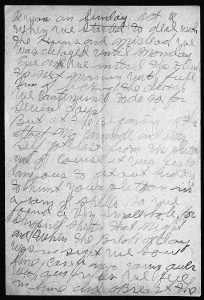
The Headquarters Company was supposed to meet its guides on October 6, at 6 p.m. and be led to its front-line position. However, the guides did not arrive until 8 p.m. At 2 a.m., the guides realized they were hopelessly lost and returned to the starting point. They had to make the dangerous trek in daylight the next day, resulting in the company having less than a day to prepare for an assault, without adequate time to map out the terrain. Musick addressed that in a written account, held by the National Archives.
Musick wrote:
“It was on Sunday, Oct 6 when we started to deal with the Huns, and mislead we was delayed until Monday eve and we entered the trench the next morning with full view of licking the dutch. We commenced to do so for several days. But at the beginning of the attack my comrade and myself got lost from the platoon and of course it was quite dangerous to get out and try to hunt your platoon in a rain of shells so we found a very small hole for shrapnel shelter that night and when the break of day was in sight we saw line company aways, going out with our rifles and fell in line and a breast the line company for two days and night without anything to eat or drink only what we would take off the ones that had fallen on the field. When night came on we started for the HQ PC which we had quite a hard time finding as we had to keep under cover as much as possible. We made it to a big road leading out from the town and along the road side we found hot coffee and corn willie (ed. note: corn beef hash). With an empty stomach we sided we go to the cars and it wasn’t very long until we desided to move as a big shell almost knocked the coffee car over. We went on farther and all at once I heard a shell burst on the opposite side of the road so we desided to get on the other side and just as we got on the other side we was knocked down by a shell it did wounds either of us and blew our helmets across the road and knocked a piece of hide from (name unclear) nose. Several hours later we found our company P.C. There we were guided to our platoon and of course we were glad to get back with our platoon. 
“The next morning we made an advance of about twelve kilo when we got to the front we still run the dutch. We moved our platoon on a small hill where we stayed for several days. Late one evening we got orders to prepare to move. An anxious bunch of men were all around thought we were going to get relieved. Dark came on and we started out and about eleven oclock. We landed on a new front we were all a little disappointed but we were still ready for the Huns. Where we made an advance we were put in a dugout that night and stayed in there thirty six hours with out anything to eat later we were moved on the front line at least that is what we thought but when we got there we found ourselves about 150 yd out in no mans land and come Sunday eve we made our last advance with out the loss of a man and then Monday night we were relieved and are now at a rest billet drilling five hours a day.
Pvt Vallie V Musick
HQ Co 142
Musick died on Oct. 21, 1967 in Cleburne and is buried in Johnson County, Texas.
Walter Hardeman
Walter Hunter Hardeman had a complicated life. He was 22, married, and employed as a cook at JA Miller’s restaurant in Burkburnett when America entered World War 1 in April 1917. He had light brown hair, brown eyes and was of medium build.
He joined the National Guard’s 7th Texas, Company F forming in Wichita County on June 29, 1917. At some point after joining his marriage ended. He served in Company K of the 142nd, but was charged with deserting the training camp at Camp Bowie in Fort Worth on Jan. 23, 1918. He was arrested in Seymour on Feb. 21. The sheriff in Baylor County captured three deserters and was paid $150 for returning them to the camp in Fort Worth.
Hardeman was found guilty of desertion and sentenced to 5 years in prison, forfeiture of pay, and dishonorable discharge. However, his discharge was suspended, and after several months in the Camp Bowie blockhouse, he was transferred into Company M when orders came to ship out in June 1918. He served as an automatic rifle operator once the company arrived in France. The Browning Automatic Rifle that Hardeman carried was designed to function as a mobile light machine gun to provide support to riflemen in an attack against trenches. The BAR operator was teamed with a soldier who carried ammunition for him. The heavy gun was supported by the sling over the shoulder, or fired from the hip. This “walking fire” was used during trench warfare.
“My experience on the front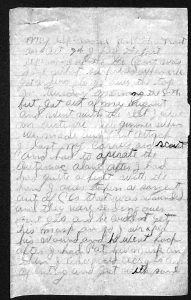
“On Oct 7th I had the first experience of the GI Cans (editor’s note: artillery shells) was. Some what surprised when we got orders to go over the top on Thursday morning the 8th but got out of my dugout and went with the lot. I was an automatic rifle gunner when we made our first attack. I lost my carrier and scout and I had to operate the automatic alone. After I had quite a fight with the huns I over taken sargent out of C Co. that was wounded and they were sending over some gas and he couldn’t get his mask on so I wraped his wound and he went back after I had put his mask on then I advanced across and operating and got with some more boys that was in my Co. they were firing into a machine gun nest and I fell into the trench with them and begun firing my automatic and two of the boys got killed and left me and (name unclear) in there alone and would have gotten whiped or captured if but our boys attacked on the flank and lucky for us the huns began to follow (name unclear) and we captured the nest.
“I believe we would have saved men if we had had the barrage that was with is in the last battle which took place on the 27th. I think that was pulled off just right but don’t care to be in another of any kind. We were relieved on the 29th. 
“Pvt WL Hardeman, Co. M 142 Inf.”
With the Armistice on November 11, 1918, the war ended. Hardeman was apparently transferred into a prison company to serve the remainder of his original sentence with hard labor. His service card records that he committed suicide less than a month later; he died on December 5, 1918 in France, he was 23.